

Free Shipping, Your Time and the Real Price of a 3D Print

The price on your listing is not what you keep. Take away the platform's fees, the postage and the hours you spent on the order, and the number left is usually a lot smaller.
Two things eat most of that gap: shipping and your own time. They're also the two things most new sellers leave out when they first set a price.
If you've already got a pricing formula you like, good. Our guide on how to price 3D printed products covers the basics. This one is about the costs that sit outside that formula.
New to Cubee? We're a design library for people who sell their prints, so the examples below come from our catalog. There's a short note for newcomers, and one for members, at the end.

Free Shipping Isn't Free, Someone Pays It
Buyers have learned to expect it. Etsy runs a free shipping guarantee for orders of $35 or more going to US buyers. It's open to sellers in any country, as long as the order ships to the US.
Surprise costs at checkout drive people away. In Baymard Institute's research, 40% of shoppers who left a cart did it because extra costs like shipping, tax and fees were too high.
But the post office doesn't deliver for free. If the buyer doesn't pay for postage on top, it comes out of your price. One way or another, somebody pays it.
There's a catch a lot of sellers miss. On Etsy, the 6.5% transaction fee is charged on the shipping too, not only the item. The payment processing fee is taken from the total with shipping as well.
So every bit of postage you collect costs you a little in fees. That's fine, as long as your price knows about it. Selling somewhere else? Our guide on where to sell 3D prints compares the fees on each platform.

How to Price Free Shipping on 3D Prints
Etsy's own free shipping guide gives the simplest answer: build the postage into the item price. The buyer sees one number, and you still get paid for the box.
To do it well, start with what you actually pay. Look up the real postage to the two or three countries you sell to most. Then add the packaging: the box, the filler, the tape.
Use your typical order, not your cheapest one. If most of your buyers are a country away, pricing on your local rate means losing money on almost every sale.
Free shipping doesn't have to mean free everywhere. A common setup is free shipping where most of your buyers are, and a flat rate everywhere else. Check your real cost to each country before you promise anything.
Big and Light Is the Expensive Kind
Carriers don't only weigh your parcel. They also charge by its size, and that's where a lot of 3D print sellers get caught out.
It's called volumetric weight. DHL's formula is length times width times height in centimetres, divided by 5,000. You pay for whichever is higher, the real weight or that number.
Take a lampshade in a 40 by 30 by 30 cm box. The print might weigh a few hundred grams, but the box counts as 7.2 kg.

That's why a lamp or a big vase can cost more to post than to print. Price those from the box size, not the weight. And use the smallest box that keeps the print safe.
Rates Go Up Every Year
Postage isn't a number you set once. In the US, USPS Ground Advantage prices went up 7.8% on January 18, 2026. UPS and FedEx both raised rates by 5.9% on average around the same time.
Australia Post raised Parcel Post prices by an average of 4.95% on July 1, 2026. And over the holidays, UPS and FedEx add peak surcharges on home deliveries.
So check your shipping costs at least once a year. If you priced a listing two years ago, its postage is probably out of date.
Your Time Is a Cost, Not Your Profit
If you paid someone else to do your job, what would it cost?

Most of us count the filament and maybe the electricity. Then whatever's left over feels like profit. But part of that "profit" is really your wage, and it disappears the moment you price it honestly.
Start by splitting the time into two kinds. Print time is the machine's time. It costs you electricity and wear on the printer, but you're free to do other things.
Hands-on time is yours. Removing the print, pulling supports, cleaning up seams, taking photos, answering messages, packing and the trip to the post office. That's the part to pay yourself for.
The easiest way to find your number is to time it for a week. Write down the hands-on minutes for each order. Most people are surprised by how much the packing and the messages add up.
Then pick an hourly rate you'd actually accept. It doesn't have to be high to start with. It just has to be real.
Take something small. Say a keychain takes about ten minutes of your hands on it, from plate to envelope. At almost any fair hourly rate, those ten minutes cost more than the plastic does.

That's why small items are often the hardest to make money on. The material is cheap, but the handling time per piece is almost the same as for something bigger.
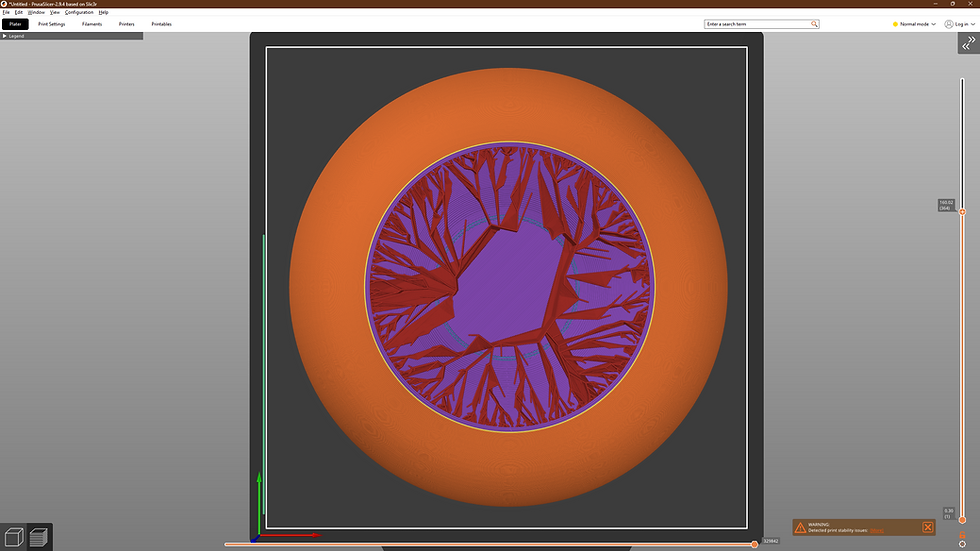
Settings help here too. Anything that cuts the minutes you spend on a print is money back, and fewer supports to pull is the easy one. Our post on lightning infill shows how much one slicer change can save on a single piece.
"How Do Other Shops Sell These So Cheap?"
You've probably seen it. A shop sells the same little toy you make for a price that barely covers your filament. How?
A few honest answers, and usually it's a mix of them.
They batch. A full plate of thirty pieces takes about the same hands-on time to set up and clear as a plate of three. Spread over thirty, the minutes per piece drop a lot.
They ship it small. A flat, light item can often go as a large letter instead of a parcel, which costs much less. They pick products that fit that size.

It's an add-on. Some shops sell the cheap item mostly to people who are already buying something bigger. The postage is paid once, by the bigger order.
They're not counting their time. Plenty of sellers price as a hobby and never add a wage. Some of them are quietly losing money on every order.
You can borrow the first three. The fourth one isn't worth copying. If a price only works because the seller works for free, it's not a price you need to match.
A Five-Minute Check Before You Set Holiday Prices
Before the rush, go through your top few listings with these questions. It takes five minutes per product.
What does it actually cost to post, to your three most common countries?
Is that postage inside the price, or added on top?
How many hands-on minutes does one order take, including packing?
After fees, postage and your time, what's left?
If it sold as part of a bundle, would the numbers look better?
If the answer to question four makes you wince, that's useful. It's much better to find out now than in the middle of December.
Where to Go From Here
If you're new here: Cubee's Hive catalog is a library of designs you're licensed to print and sell, from independent designers. Every catalog example in this post comes from it. Membership comes with a commercial licence, so what you print from the catalog is yours to sell.
If you're already a Hive member: run your top three products through the price calculator in Hive Design Tools this week. Put in the real postage and your hands-on minutes, not the guesses.
Then tell us in the members' Discord how your numbers changed. I'm curious which costs surprised you most.
Happy pricing, and happy printing!


Comments