

Selling 3D Prints Locally: Markets, Pop-Ups, and Gift Shops Without the Awkward Pitch

Updated: Oct 13

Selling in person is a completely different game from selling online — and in a lot of ways, it's a better one.
You get to talk to your customers. You get to test your products in real time. You get instant feedback — not a review three weeks later, but a reaction right in front of you. You get testimonials you can use tomorrow. You get to experience the entire sales cycle, from first impression to "I'll take two," in the span of a single conversation.
Flea markets, pop-ups, and gift shops are real revenue channels for 3D printing sellers and they're channels that most people either overlook or try once without preparation and walk away too early.
In this guide, we unpack everything you need to know, from choosing the right product to setting up a booth that sells before you open your mouth, to walking into a gift shop without that cringe-worthy pitch.
Let's pop-up the products!
The Product Comes Before Everything Else

Walk through any craft market and you'll spot it immediately. There are often multiple booths selling near-identical things — Articulated animals. Glow keychains. Planters. Vases.
When buyers see the same products across three consecutive tables, price becomes the only decision left. That race doesn't end well for anyone. And a gift shop owner who's already seen your exact product from another seller has zero reason to stock yours.
Whether you're setting up a booth or walking into a store, the same problem follows you if your product doesn't stand out.
There are directions that do work in both settings.
Local identity products move well everywhere. Sports teams, city landmarks, regional symbols — buyers can't find them elsewhere easily, and there's a genuine connection to the item.
A "Welcome to [Your Town]" sign or a coaster shaped like a local lake/ground hits differently than a generic desk toy. Gift shop owners love this angle too, because "locally made" is a selling point they can pass directly to their customers.
Functional items for specific hobbies cross over just as easily. Cookie cutters in unexpected shapes, guitar pick box in a head stock form, wall organizers that actually look good, hobby-specific holders and mounts. These fill gaps that mass retail ignores.

At a market, they give you a natural talking point. In a gift shop, they fill a niche the owner can't easily source elsewhere.
One approach worth trying at markets: treat your booth as a showroom, not a warehouse. Display samples. Show what you can make. Take orders. Buyers get something made for them, you reduce inventory risk, and the conversations tend to be better; because they're about intent, not just impulse.
The bottom line is this: product selection is not a default decision.
Whether you're setting up at a farmers market next Saturday or walking into a boutique downtown, go in knowing exactly why someone should choose what you're offering.
Selling at Markets and Pop-Ups

Once your product is solid, the next question is where to show up. Not every event draws the same crowd. The product that flies off the table at a farmers market might sit untouched at a holiday pop-up, and vice versa.
Community fairs and farmers markets reward accessibility. Lower prices, high visual appeal, impulse buys. Parents with kids are often your best prospects here.
A low-cost entry product which is something in the $3 to $5 range, gets people physically interacting with your table. The higher-value items sell once they're already engaged and browsing.
Pop-ups and themed events reward alignment. If your designs belong in that space, you barely need to sell at all.
A horror-themed market and a spring garden fair are completely different worlds. Go where your work already fits and let the context do the heavy lifting.
Before committing to any event, spend time there as a customer first. Watch what sells. Notice what's already there. Ask yourself honestly whether your product belongs in that space, or whether you're just hoping foot traffic will carry you.
Your Setup Sells Before You Say a Word
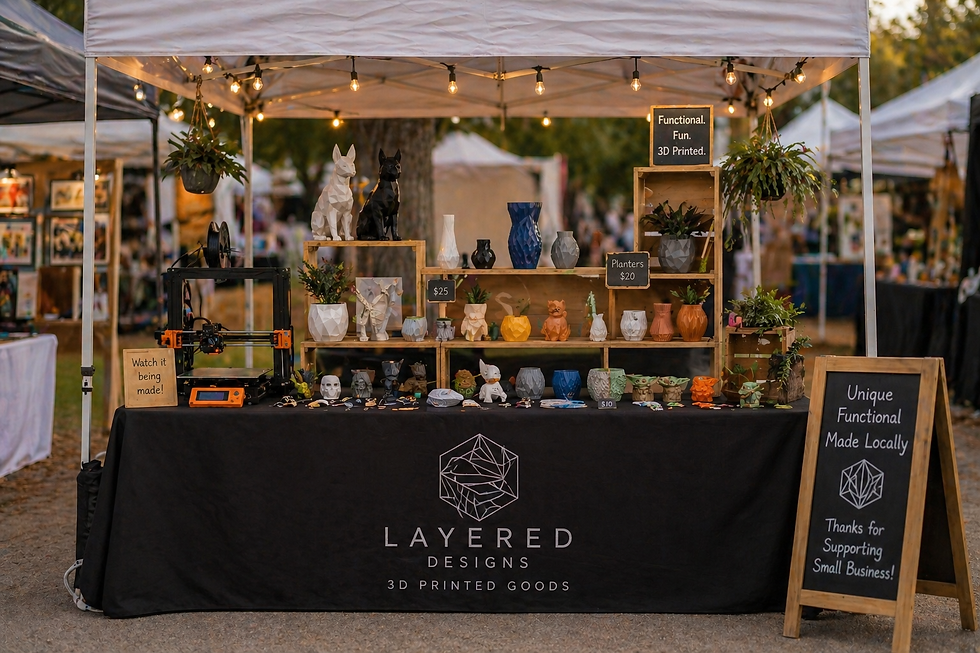
Picking the right event gets you in the room. But people decide whether to stop at your table before you ever speak ; and a flat table filled with products is easy to walk right past.
From a distance, height wins. Use risers, tiered displays, anything that breaks the flat-table look and makes your work visible while people are still walking. If they can see something interesting from across the aisle, they'll start drifting your way.
Up close, pricing clarity wins. Nobody wants to ask how much something costs. Label
everything clearly so buyers can figure out if it fits their budget before they engage.
That $3–$5 entry item does double duty here — it removes the "is this expensive?" hesitation and gets someone to physically pick something up. Once they do, they're far more likely to explore everything else on your table.
And anything that increases dwell time helps. A printer running live. Something interactive they can touch or customize. People who stay are a completely different kind of prospect than people who glance and keep walking.
Think of your setup as a funnel: visibility pulls them in, clear pricing removes hesitation, and something engaging keeps them there long enough to find what they actually want.
Getting Into Gift Shops

Markets are about showing up for a day and making the most of it. Gift shops are a longer game — but once you're in, your products sell while you're at home printing the next batch.
The mistake most people tend to make is treating a gift shop like a market booth with a gatekeeper.
They walk in, lead with what they want, and hope for the best:
"I make 3D printed home decor and I'm looking for shops to carry my work."
That's a pitch. And it's easy to say no to — because it's entirely about you.
Here's the reframe: your first job isn't to close anything.
It's to earn the next conversation. Think about it in two stages.
Stage One: Thirty Seconds to Get Them Curious
The goal is simple — spark enough interest to keep talking.
Something like: "I make locally produced home decor. I've been looking at your store and I think a few pieces would fit really well here. Would you be open to taking a look?"
No catalog dump. No pricing sheet. Just a reason to continue.
Notice the difference: you're not asking them to carry your work. You're asking if they'd be open to seeing it. That's a much easier yes.
Stage Two: Show What Belongs in Their Store

If they're open, bring three to five samples that actually match that store's aesthetic. Not everything you make — only what belongs there.
Come prepared. Know your wholesale pricing (typically 40–50% of retail). Know your restocking timelines. And have a consignment option ready — it lowers the barrier significantly. You're not asking them to invest upfront; you're asking for shelf space and a test run. A 60/40 split in the shop's favor is fairly standard.
If you're local, say it early. It matters more than you think.
Leave samples. Leave a card. Don't push for a decision on the spot. Follow up once, briefly, about a week later. If it's not a fit, ask if they know other shops that might be interested. Remember, shop owners talk to each other, and a warm referral is worth more than ten cold visits.
If you want to start sharpening this skill, check out Benoit's video on perfecting your pitch — it'll give you quick, practical insights on how to talk to prospects without sounding like you're reading from a script.
There's also a concise blog version if you prefer to skim the key points.
Where to Start This Week

If you've been thinking about local selling but haven't started, pick the path that fits your situation right now.
If you want to start with gift shops — they're lower pressure than a market, there's no booth fee, and you can approach on your own schedule. Pick two stores where your work fits naturally. Visit them as a customer first.
Look at what they carry, how they price, what the vibe is. Then build three to five samples specifically for each store. These don't need to be your greatest hits, but pieces that belong on their shelves. Know your pricing before you walk in, and have the short version of the conversation ready.
If you want to start with markets — find one event that fits your product and commit to doing it well. Right products, right audience, clear display, transparent pricing.
Don't just fill a table with everything you've printed. Curate it. Set up your display with height and signage. Price everything visibly. Bring a low-cost entry item that gets people to your table.
Either way, don't judge the outcome from one attempt. Or even two. Keep adjusting.
You'll know you're onto something when people stop like they've found something they haven't seen before.
If you've already sold at a local market or landed a gift shop deal, share what worked and what didn't inside the community. Real experience helps everyone figure this out faster.
Comments